
The Battlefield community is once again proving its passion — and precision. Over the weekend, fans meticulously measured 70+ maps from Battlefield 3 all the way to the newly released Battlefield 6, fueling an ongoing debate about map size and game design.
This project, led by Reddit users ClaraTheRed and PENGUINonPC, turned into a massive collaboration that spanned more than 45 hours of analysis. It compared maps across six Battlefield titles — including Battlefield 3, 4, Hardline, 1, 2042, and 6 — using color-coded charts and side-by-side visuals. The results paint a clear picture of how EA’s map design philosophy has evolved over the last decade and a half.
The Results: Smaller, Tighter Maps in Battlefield 6
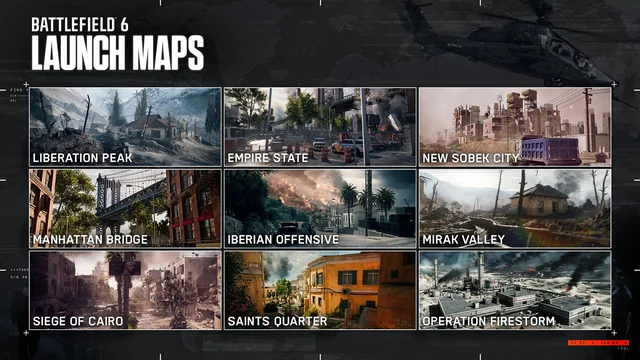
According to ClaraTheRed’s analysis, Battlefield 6’s maps are smaller than many longtime fans expected. While some maps like Iberian Offensive or Siege of Cairo match the compact layouts of Battlefield 3 and Battlefield 1, none of the new entries rank among the top 20 largest maps in franchise history.
Even the largest Battlefield 6 map — Operation Firestorm, a remake of the Battlefield 3 classic — ranks 32nd overall in total shared playable area and 22nd in total map area. That discovery has set off intense discussions across Reddit, YouTube, and Discord.
“We’re not here to complain,” ClaraTheRed clarified. “We just wanted to show that Battlefield maps have always varied tremendously in size.”
Why Fans Are Divided
Despite the data-driven nature of the study, the findings have reignited one of the oldest Battlefield arguments — bigger isn’t always better. Some players claim that smaller, more focused maps create better pacing and firefights. Others argue that Battlefield’s identity has always been tied to grand-scale combat.
The debate intensified after EA’s launch of Battlefield REDSEC, a standalone offshoot connected to Battlefield 6. EA claims that its REDSEC map, Fort Lyndon, is the biggest Battlefield map ever, but fans note it technically belongs to a different mode — a battle royale experience, not the core multiplayer lineup.
The Evolution of Battlefield Maps
One reason this debate matters is that Battlefield’s map design defines its gameplay identity. From BF3’s Caspian Border to BF1’s Sinai Desert, each generation reflected changing priorities — scale, destruction, and realism.
Yet, Battlefield 6 seems to pivot toward medium-sized arenas, suggesting EA may be experimenting with player density, cover, and flow rather than just raw map scale. And while Battlefield V data wasn’t included in the fan study due to lack of resources, its omission only deepens the curiosity around how EA’s design approach has evolved.
EA’s Response and What’s Next
Since launch, EA and Battlefield Studios have pushed out multiple updates, including Season 1’s “Blackwell Fields” map and a second new area, Eastwood, set to arrive later this month. According to insiders, more maps and performance optimizations are planned through early 2026.
In addition, the studio has hinted at dynamic map changes returning in future seasons — reminiscent of Levolution from Battlefield 4 — which could reintroduce the large-scale chaos fans miss.
🔗 Related Reads (Internal Links)
- Read our full Battlefield 6 Review and Launch Analysis
- Explore our Top 10 FPS Games of 2025
- Check out our Call of Duty vs Battlefield Comparison
🌐 External Sources
💬 Final Thoughts
The Battlefield 6 map debate highlights what makes the franchise so special — its community’s passion for data, design, and detail. Whether you prefer massive open warfare or tight urban battles, there’s no denying that players’ dedication to the series is unmatched.
As new maps and updates arrive, expect this discussion to keep evolving — and Gamer4Life will be tracking every pixel of it.