
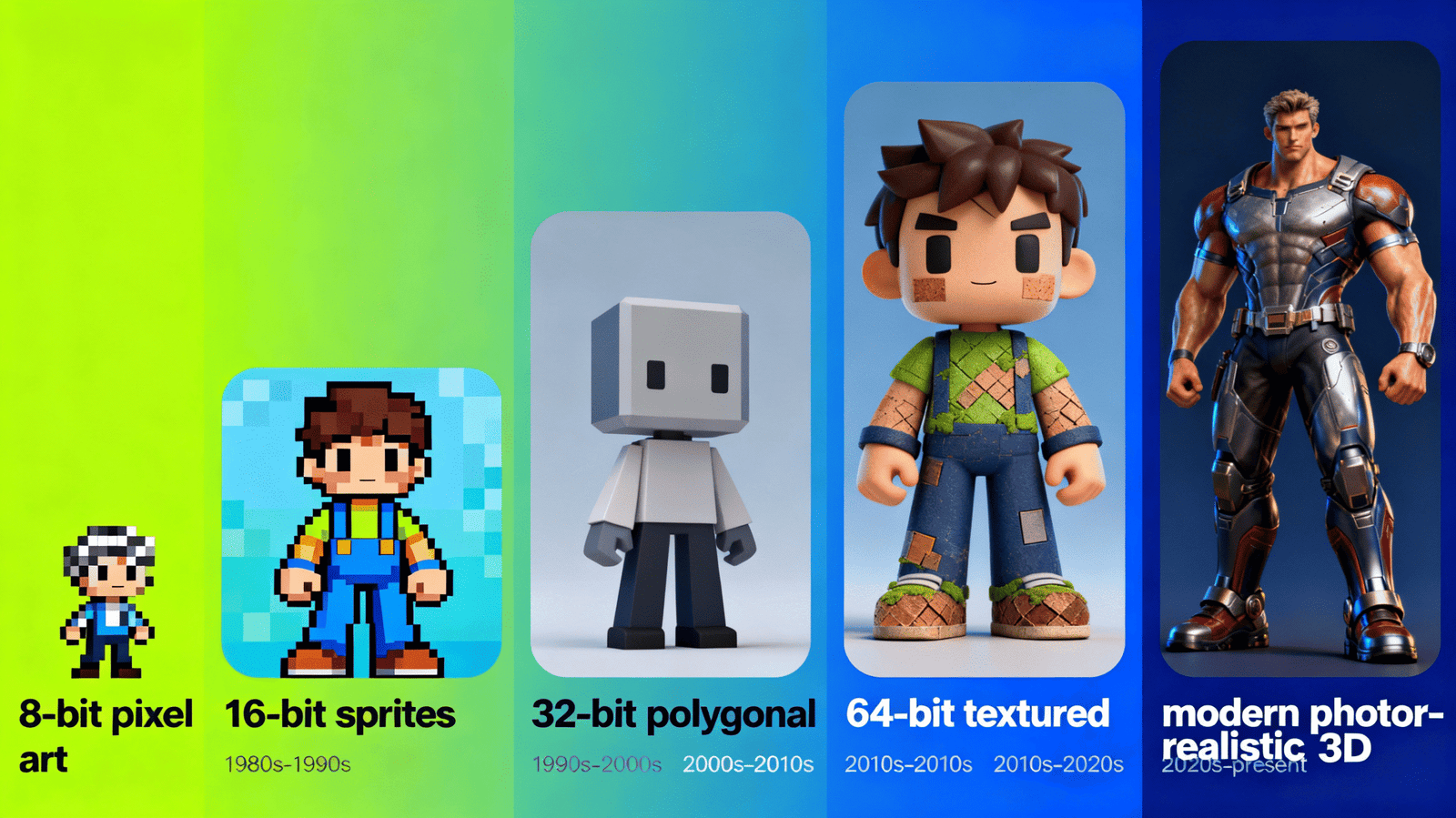
Gaming graphics have undergone a revolutionary transformation over the past four decades. What started as simple colored pixels on a black screen has evolved into breathtakingly realistic 3D worlds that blur the line between games and reality. Understanding this evolution reveals not just technological progress, but how our expectations for gaming experiences have fundamentally changed.
The 8-Bit Era: Where It All Began
In the 1980s, gaming graphics were defined by severe limitations. The Nintendo Entertainment System (NES) and arcade cabinets could only display a handful of colors on screen at once. Sprites were small, animations were jerky, and developers had to be incredibly creative within these constraints.
Games like Super Mario Bros. and The Legend of Zelda became iconic not despite their simple graphics, but because developers maximized visual impact within technical boundaries. These pixelated characters became instantly recognizable and remain beloved today, proving that artistic direction matters more than raw power.
The 16-Bit and 32-Bit Revolution
The 1990s brought dramatic improvements with the Super Nintendo Entertainment System (SNES) and Sega Genesis. More colors, larger sprites, and smoother animation made games feel more alive. The Sega Saturn and Sony PlayStation introduced 3D graphics, marking the transition from 2D sprite-based games to fully three-dimensional environments.
Early 3D games looked primitive by modern standards, with low polygon counts and flat textures. However, titles like Final Fantasy VII and Super Mario 64 demonstrated the incredible potential of 3D gaming and captured players’ imaginations in ways 2D games could not.
The Polygon Revolution: PS2 and Xbox Era
The PlayStation 2 and original Xbox represented a massive leap forward. Real-time lighting, advanced texturing, and higher polygon counts created game worlds that felt genuinely immersive. Developers could now craft detailed environments with complex lighting effects that responded dynamically to gameplay.
Games like Metal Gear Solid 2, Grand Theft Auto III, and Halo showcased what modern hardware could achieve. Character models became more detailed, facial animations improved dramatically, and environments felt less like flat backdrops and more like living, breathing worlds.
High Definition and the Power of Realism
The PlayStation 3 and Xbox 360 generation brought gaming into the HD era. Graphics became sharper, environments more detailed, and cinematic experiences more believable. Developers focused on photorealism, creating characters with realistic skin textures, hair simulation, and complex facial expressions.
This era introduced popular franchises that relied heavily on visual fidelity, like Uncharted, The Last of Us, and Red Dead Redemption. Games began to feel like interactive movies, with character animations and environmental details reaching unprecedented levels of sophistication.
Current Generation: Chasing Perfection
Modern consoles like the PlayStation 5 and Xbox Series X, combined with high-end PC gaming, have pushed graphics to near-photorealistic levels. Ray tracing technology simulates realistic light behavior, creating reflections and shadows that look like real photography. 4K resolution and high frame rates (up to 120fps) make motion smoother and more lifelike.
Games like Cyberpunk 2077, Elden Ring, and Alan Wake 2 showcase environments so detailed you can spot individual raindrops on windows. Character models have hair strands that move individually, sweat that drips realistically, and facial expressions that convey genuine emotion.
AI Upscaling: The Next Frontier
Artificial intelligence is beginning to revolutionize gaming graphics through upscaling technologies like NVIDIA’s DLSS and AMD’s FSR. These technologies use AI to upscale lower-resolution images to higher resolutions without sacrificing visual quality, allowing developers to deliver stunning graphics while maintaining smooth frame rates.
This technology democratizes high-fidelity gaming, making photorealistic graphics accessible on mid-range hardware rather than requiring expensive gaming PCs or the latest consoles.
Ray Tracing: Realistic Lighting
Ray tracing calculates how light behaves in real environments, creating reflections, refractions, and shadows that behave exactly like real light. While computationally expensive, ray tracing is becoming standard in modern games, transforming how worlds look and feel.
Games with full ray tracing enabled look almost indistinguishable from pre-rendered cinematics, creating immersive experiences that pull players deeper into game worlds.
The Future: Where Graphics Are Heading
The next generation of gaming hardware and technology will likely focus on:
Real-time Global Illumination: Lighting that bounces and reflects naturally throughout entire game worlds without requiring baked lighting data.
Neural Rendering: AI-driven graphics that can generate realistic imagery in real-time, potentially replacing traditional rendering pipelines.
Variable Rate Shading: Focusing rendering power on areas the player is looking at, allowing for more detailed graphics where it matters most.
Haptic Feedback Integration: Graphics paired with advanced haptic technology that lets players feel textures and impacts, creating more immersive sensory experiences.
Does Graphics Quality Really Matter?
While technological advancement is impressive, the best games balance graphical fidelity with solid gameplay and engaging stories. Indie games with stylized graphics often resonate more deeply with players than AAA titles with cutting-edge visuals but weak narratives.
The evolution of gaming graphics shows that technology should serve the creative vision, not the other way around. A game with intentionally simple pixel art can be more memorable than a photorealistic experience with hollow gameplay.
Conclusion
The evolution of gaming graphics represents one of the most dramatic technological progressions in entertainment history. From 8-bit sprites to photorealistic 3D worlds powered by AI, gaming has continuously pushed the boundaries of what’s possible on screen.
As technology continues to advance, the focus will shift from simply looking better to creating experiences that feel more immersive and emotionally resonant. The future of gaming graphics isn’t just about photorealism—it’s about creating worlds so convincing that the line between game and reality becomes meaninglessly blurred.
These sources cover all the major topics in your blog including 8-bit graphics, the 3D revolution, ray tracing technology, and modern AI upscaling. You can cite these in your blog to add credibility and give readers places to learn more!
- https://300mind.studio/blog/the-evolution-of-video-game-graphics/
- https://inlingogames.com/blog/the-evolution-of-video-game-graphics/
- https://www.rmcad.edu/blog/the-evolution-of-video-game-art/
- https://www.edgeofnft.com/podcasts/journey-through-the-history-of-video-game-graphics
- https://en.wikipedia.org/wiki/Ray_tracing_(graphics)
- https://www.pcmag.com/how-to/what-is-ray-tracing-and-what-it-means-for-pc-gaming
- https://www.nvidia.com/en-us/geforce/rtx/
- https://www.velocitymicro.com/blog/dlss-vs-fsr-upscaling-comparison/
- https://www.darkflash.com/article/differences-between-fsr-4-and-dlss-4
- https://gamertech.org/singlenews/4K-Upscaling