
Overview
Released by Taito in 1978, Space Invaders is one of the most influential video games ever made. Designed by Tomohiro Nishikado, it helped kick off the golden age of arcade games and shaped how shooters would work for decades.
Gameplay
You control a small laser cannon at the bottom of the screen, moving left and right while shooting descending rows of alien invaders. The aliens move slowly at first, but as you destroy them, the remaining invaders speed up—creating rising tension. Occasional UFOs pass overhead for bonus points, and simple shields provide limited protection.
The controls are easy to learn, but the challenge ramps up quickly. This balance made Space Invaders accessible to new players while still being addictive for experienced ones.
Graphics & Sound
By modern standards, the graphics are extremely simple—blocky, monochrome sprites—but in 1978 they were striking and memorable. The steadily accelerating four-note soundtrack is especially iconic. As the invaders get closer, the sound speeds up, increasing the player’s stress and excitement in a way that was groundbreaking at the time.
Innovation & Impact
Space Invaders introduced or popularized several major ideas:
- Persistent high scores, encouraging competition
- Increasing difficulty over time instead of fixed levels
- Enemies that react as a group rather than individually
The game became a cultural phenomenon, driving arcade popularity worldwide and inspiring countless sequels, clones, and future shooters like Galaga and Gradius.
Replay Value
Despite its simplicity, Space Invaders has strong replay value. The desire to beat your previous score—or someone else’s—keeps players coming back. However, gameplay variety is limited compared to later titles.
Historical Context
When Space Invaders launched in 1978, video games were still a novelty. Most arcade titles before it were either sports-inspired (Pong) or simple reaction games. Space Invaders was revolutionary because it introduced constant pressure and progressive challenge, making players feel like they were fighting a losing battle against an advancing force.
In Japan, the game became so popular that it reportedly caused coin shortages in arcades. Internationally, it helped legitimize video games as a mainstream form of entertainment rather than a passing fad.
Game Design & Mechanics
Player Control
You control a laser cannon that moves horizontally across the bottom of the screen. There is no vertical movement, which forces players to focus on timing, positioning, and anticipation rather than reflex-heavy movement.
Enemy Behavior
The invaders move as a single formation, shifting side to side and descending after hitting the screen edge. This was a major design innovation—enemies weren’t random; they behaved as a system. As invaders are destroyed, the remaining ones move faster, creating a natural difficulty curve without changing levels or adding new enemies.
Difficulty Scaling
Instead of traditional stages, difficulty increases dynamically:
- Fewer enemies = faster movement
- Less reaction time = higher tension
- The final invader becomes extremely fast, testing player precision
This design ensures that every round ends in near panic, which keeps players engaged.
Strategy & Skill Depth
Although it looks simple, Space Invaders rewards smart play:
- Target prioritization: Skilled players often shoot edge invaders first to slow descent timing.
- Shield management: Barriers degrade over time; standing too close can damage them with your own shots.
- Shot timing: Only one player shot can be on screen at a time, making accuracy critical.
- Risk vs. reward: Chasing the UFO can earn high points but distracts from the advancing threat.
High-level play becomes about controlling chaos, not just surviving.
Audio Design & Atmosphere
The sound design is minimal but brilliant. The iconic four-beat rhythm speeds up as the aliens descend, acting like a heartbeat that mirrors player anxiety. This was one of the first times audio was used psychologically, not just for effects.
Sound cues also provide gameplay information:
- Alien movement rhythm
- Player shot confirmation
- Incoming danger
Visual Presentation
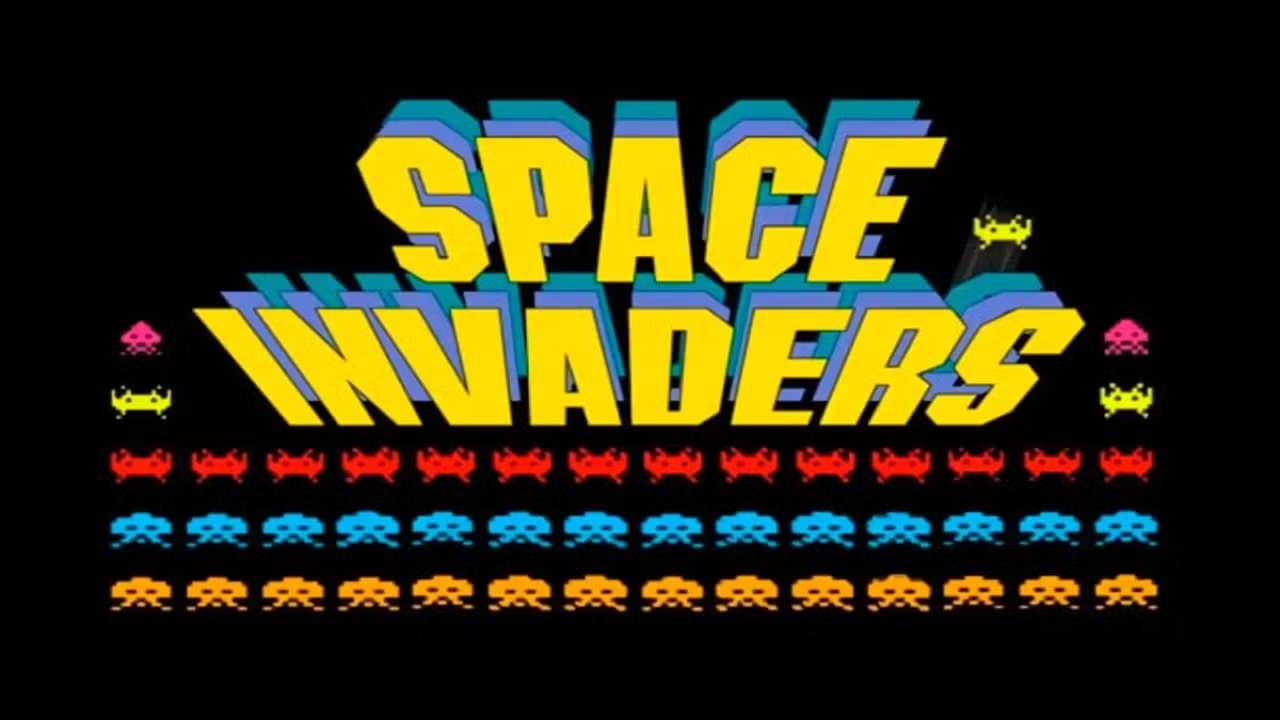
The visuals are stark: black background, white (or color-overlay) sprites, and simple animations. However:
- Each alien type has a distinct shape and animation.
- The symmetry of the formation reinforces the feeling of an organized invasion.
- The slow, deliberate descent creates suspense rather than chaos.
The simplicity helps readability—players can instantly assess danger.
Technical Achievement
Tomohiro Nishikado built much of the hardware himself because existing arcade systems couldn’t handle the game. Interestingly, the alien speed increase wasn’t originally intentional—it happened because the processor had less work to do as invaders were removed. This “bug” became one of the game’s most famous features and a defining mechanic.
Cultural & Industry Impact
Space Invaders changed the video game industry in lasting ways:
- Popularized high-score chasing
- Helped establish the shooter genre
- Inspired home console ports, boosting sales of systems like the Atari 2600
- Influenced game design philosophy focused on tension and mastery
Its imagery—pixel aliens, bunkers, laser cannon—is still instantly recognizable today.
Modern Perspective
By today’s standards:
- There’s little narrative or variety
- Repetition is unavoidable
- Controls are extremely limited
However, as a pure skill-based arcade game, it remains compelling. Modern indie games that focus on minimalist design and escalating tension owe a lot to Space Invaders.
Final Assessment
Space Invaders is not just an old game—it’s a foundational design blueprint. Its lasting power comes from how much tension, strategy, and excitement it creates with almost nothing.
Strengths
- Elegant, scalable difficulty
- Strong atmosphere through sound
- Deep strategy beneath simple mechanics
Weaknesses
- Limited variety
- Repetitive over long sessions
Final Verdict
Space Invaders is a landmark in video game history. While it may feel repetitive or primitive today, its design, tension, and influence are undeniable.
Rating (for its time): ★★★★★
Rating (by modern standards): ★★★☆☆
Below is gameplay of “space invaders” by World of Longplay