
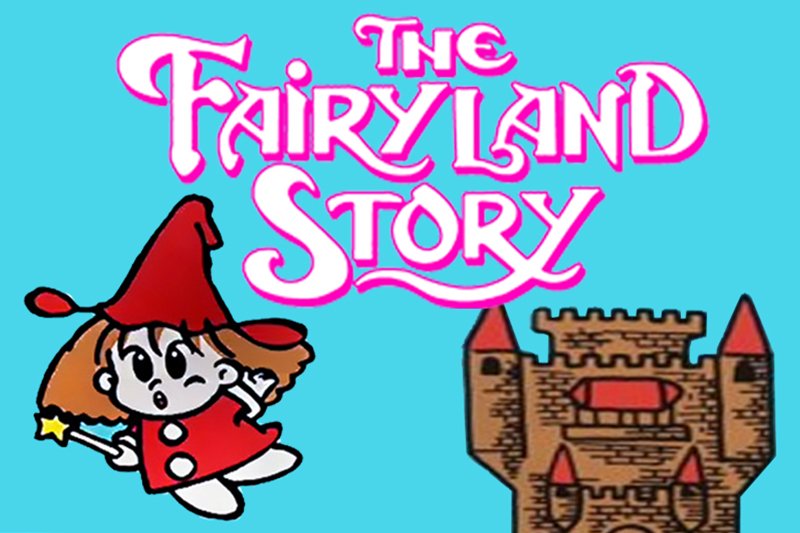
Here’s a breakdown and review of The Fairyland Story, Taito’s 1985 arcade platformer — what works, what doesn’t, and why it’s still remembered today.
What Is The Fairyland Story?
- Released in arcades by Taito in July 1985. Before being ported to other systems
- Designed by Hiroshi “ONIJUST” Tsujino, with music by Y. Tsuchida.
- The player controls Ptolemy, a young witch navigating 101 single-screen stages.
- Her main power: turn enemies into cakes, then push/drop those cakes off platforms to crush other enemies.
- If you squash multiple enemies with one cake, you get bonus points, sometimes extra bonuses.
- Interestingly: if Ptolemy touches an enemy (unless she jumps on their head), she’s trapped in a bubble and flies away. The defeated enemies resurrect when she returns.
- Originally intended to loop or continue, but the continue option is removed near the end (around Stage 99) in some versions.
- It was ported to MSX and Sharp X68000 later.
- A Famicom (NES) port was developed (circa 1986) but canceled; a prototype build was later discovered.
- More recently, it’s been re-released via Arcade Archives on PS4 and Nintendo Switch.
Pros / What Makes It Special
- Cute, Quirky Visuals & Theme
- The game leans into a very whimsical, fairy-tale aesthetic, with cartoony fantasy creatures.
- Ptolemy, the witch, is charming and expressive: her animations and reactions give the game personality.
- Unique Game Mechanic
- The “turn into cake then crush” system is pretty novel and memorable. Rather than just shooting or stomping enemies, you’re using a more strategic mechanic.
- The squash bonus (killing multiple with one cake) introduces a risk/reward or combo-style play.
- Lots of Content
- With 101 stages, there’s real depth and diversity.
- Stage variety: you move through castles, forts, and even surreal dessert-like stages.
- Historical Importance
- It’s often seen as a precursor to Bubble Bobble — some of the gameplay design, charm, and Taito platformer DNA carry forward.
- For retro gaming fans, its re-release via Arcade Archives makes it more accessible.
- Challenge & Strategy
- Later levels become quite tricky: precise jumps, timing, and remembering enemy behavior matter a lot.
- Magical power-ups (scrolls) upgrade Ptolemy’s spells, adding variety.
Cons / Drawbacks
- High Difficulty Curve
- As you progress, the game gets very hard. The control feels a bit stiff, which can make platforming finicky.
- Because of how punishing some later stages are, continuing is limited or removed, which can be frustrating.
- Repetition Over Time
- While 101 levels is a lot, the core mechanic (turn-and-crush) doesn’t evolve dramatically, so it can feel repetitive once you master the system.
- Limited Modern Recognition
- Despite its innovation, The Fairyland Story didn’t spawn a huge franchise; it’s more of a niche or cult classic.
- The canceled Famicom port means less mainstream nostalgia or reach than some contemporaries.
- Emulation / Port Concerns
- The Arcade Archives port uses the Japanese ROM as its basis.
- For some players, modern emulation might make the difficulty feel harsher (especially without the continue) — though save states help if you’re emulating.
Legacy & Impact
- Though not as famous as Bubble Bobble, it’s historically influential: many elements in Bubble Bobble and other Taito platformers trace back to this game.
- The discovery of the unreleased Famicom prototype in 2022 created buzz in retro circles.
- It’s part of Taito’s “comical action” tradition — whimsical but challenging, simple mechanics with cute visuals but serious depth.
My Verdict
- Strengths: Very creative mechanics, a lot of stages, whimsical design, and real retro-platformer charm.
- Weaknesses: Gets difficult, can feel repetitive, and may not appeal to players who want very modern or highly polished platformers.
- Who it’s for:
- Retro gamers looking for lesser-known arcade platformers
- Fans of Taito’s cute but tough design philosophy
- Players who enjoy skill + strategy over brute action
If you’re into vintage arcade games, The Fairyland Story is absolutely worth playing. Its nostalgic charm, unique mechanics, and ambitious stage design make it a hidden gem in Taito’s catalog.
You can find gameplay video of “The Fairyland Story” below. Credits to “World Of Longplay” for the gameplay footage.