
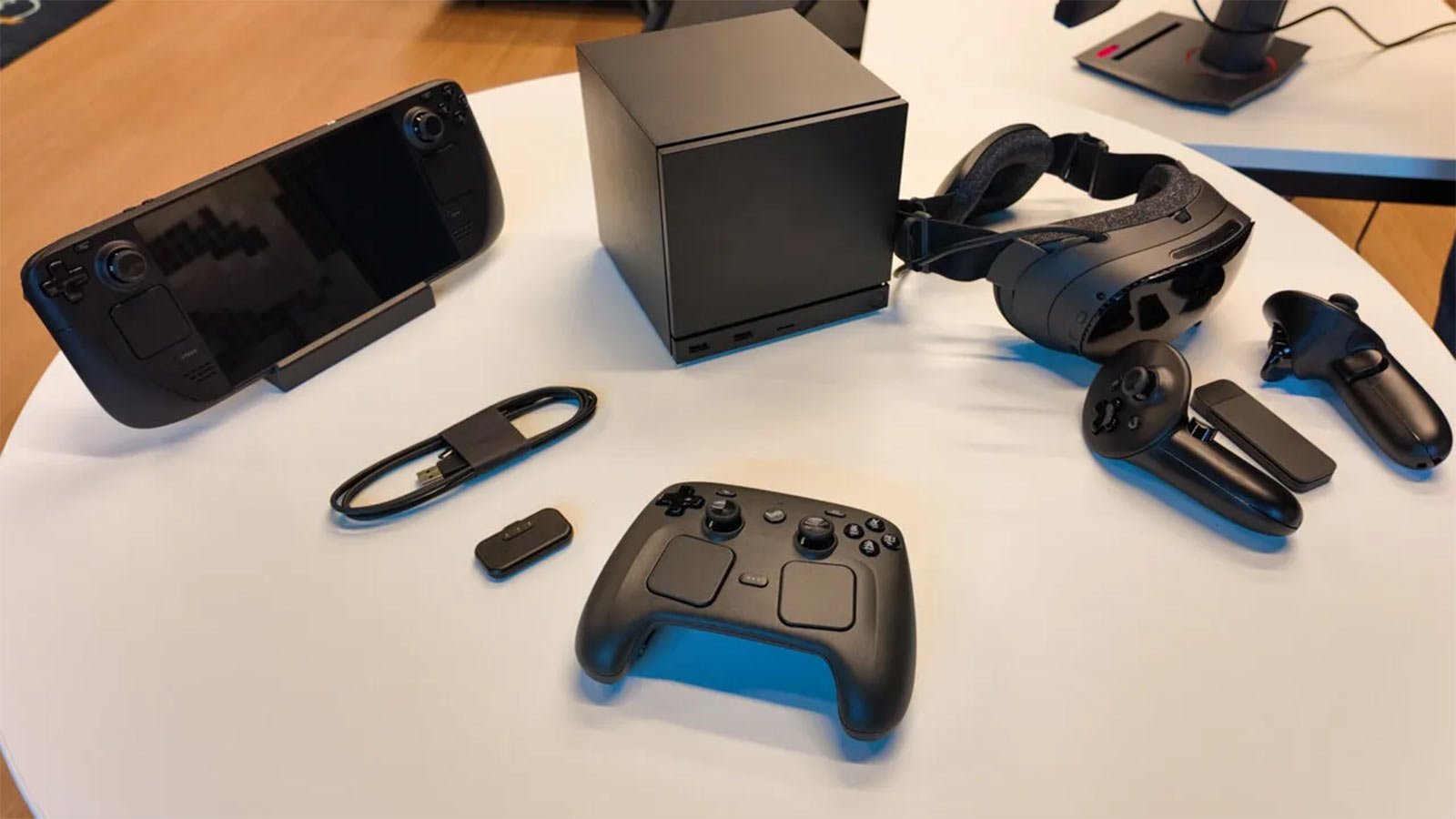
What’s the New Steam Machine (2025)?
- Valve Just Announced It
- On November 12, 2025, Valve revealed a brand-new Steam Machine.
- It’s not a retro throwback — this is a modern “living-room” PC box.
- It runs SteamOS, just like the Steam Deck.
- Specs & Power
- According to Valve, the new Steam Machine is “six times more powerful than the Steam Deck.”
- CPU: Semi-custom AMD Zen 4, 6 cores / 12 threads.
- GPU: Semi-custom AMD RDNA 3, 28 CUs.
- RAM: 16 GB DDR5 (upgradeable) per reports.
- Storage: Two models — 512 GB or 2 TB, with microSD slot for expansion.
- Connectivity: Ports include DisplayPort 1.4, HDMI 2.0, Ethernet (1 Gb), USB-C, USB-A, Wi-Fi 6E, Bluetooth.
- Power: It has an internal power supply, so no huge external power brick.
- Form Factor: Roughly a 6-inch cube.
- RGB / LED: There’s an LED strip so you can get visual feedback (downloads, status, etc.) that’s customizable.
- Performance Goals
- Valve aims for 4K gaming at 60 fps, leveraging upscaling (like FSR) to hit that.
- Because of Proton (Steam’s compatibility layer), many Windows games should run on this SteamOS box.
- When Is It Coming / Price
- Release Date: Valve says it will ship in early 2026.
- Price: Not officially announced yet.
- Valve has said they want it to be “affordable” and competitive with other consoles.
- Positioning
- Valve sees it as a PC, not just a console: “you can install your own OS or apps.”
- But it does overlap with traditional consoles in use-case: couch gaming, living room setup.
- They’re expanding their “Steam Verified” program to include this new Steam Machine so buyers know how well games will run.
- Other New Hardware
- Along with the new Steam Machine, Valve revealed:
- A new Steam Controller — with magnetic thumbsticks + trackpads.
- A VR headset called the Steam Frame, which also runs SteamOS.
- Along with the new Steam Machine, Valve revealed:
Previous incarnation of the Steam Machine by Valve
The Steam Machine was a line of living-room gaming PCs created around 2013–2015 as part of Valve’s effort to bring PC gaming to the console space.
🔍 What It Was
A Steam Machine wasn’t one single console—multiple hardware manufacturers (Alienware, Zotac, Gigabyte, etc.) built their own models. All were designed to:
- Run SteamOS (Valve’s Linux-based operating system)
- Be used with the Steam Big Picture interface
- Work well in a living-room setup (like a PS4 or Xbox)
- Support the optional Steam Controller
💻 Key Features
- PC hardware inside a console-like form factor
- Customizable (some models could be upgraded like a traditional PC)
- Linux-based SteamOS with a focus on performance and openness
- Access to the Steam library, but limited to games that supported Linux or SteamOS at the time
📉 Why They Didn’t Succeed
Steam Machines struggled because:
- Limited native Linux game support (many games were Windows-only)
- Performance and price varied widely
- Confusion due to many different models
- Windows gaming PCs already served a similar purpose
🎮 What Replaced Them?
The concept eventually evolved into:
- Steam Deck (2022), Valve’s very successful handheld PC
- SteamOS 3 and Proton, which allow Windows games to run on Linux smoothly
So, the Steam Machine was an early attempt at a console-like PC gaming experience, but the idea didn’t really take off until later with the Steam Deck.
⚠️ Things to Keep in Mind / Risks
- Because it’s still a PC at heart, you may run into games that don’t support Linux / Proton perfectly — especially anti-cheat-heavy multiplayer games.
- The price is unknown, so we don’t know exactly how “affordable” it will be in practice.
- As with any new console-PC hybrid, early adopters might deal with hardware or software quirks.
The video below is the announcement of the new steam hardware, please check out the trailer if you have not seen it yet.